

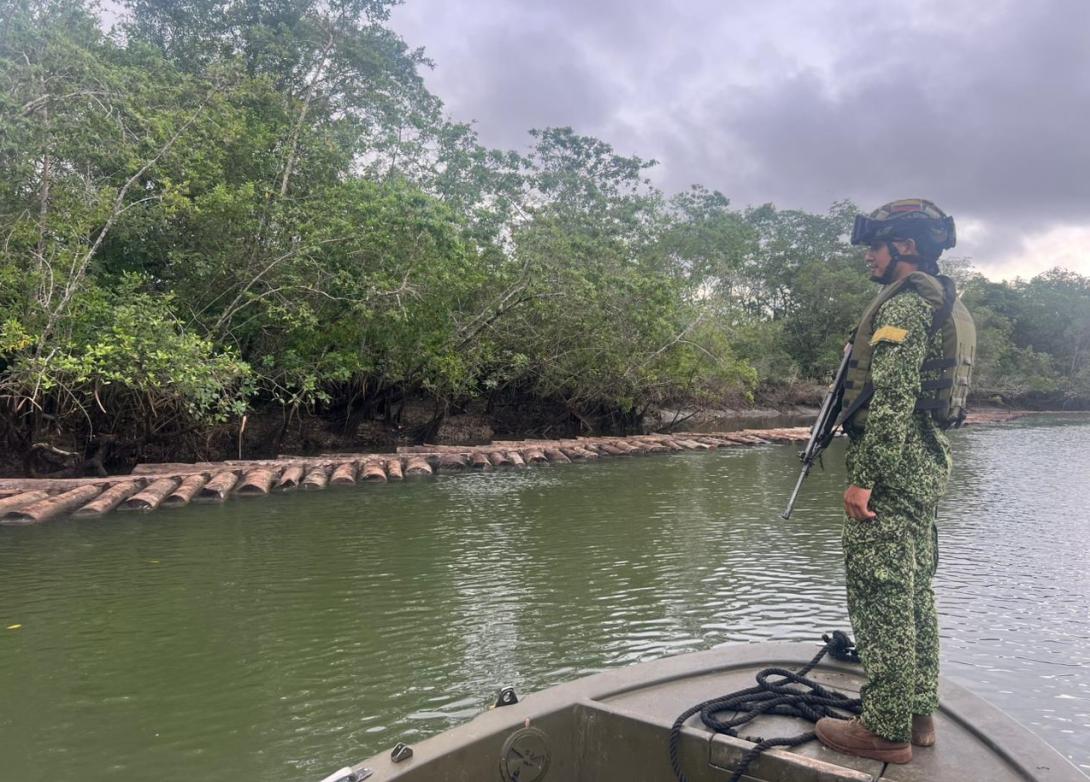
In fulfillment of its commitment to the protection of the environment and the preservation of natural resources, the Colombian Navy, through the Navy Infantry Brigade No. 2, reported the seizure of 1,040 cubic meters of wood that was being transported illegally, during river control operations in the municipality of Bajo Baudó, Chocó department.
The first result of the military operation was reported on the Ijuá River, in the Meluk Port, where troops of the Navy Infantry River Battalion No. 22 intercepted a ship carrying 951 pieces of wood of the otobo and sajo specimens. During the search it was evident that the elements were transported without the documentation required by the environmental authority, which is why five individuals involved in this illegal activity were arrested.
Simultaneously, in a second action carried out on the Catripe River, in the sector known as Punta Purricha, units of the Colombian Navy detected a ship sailing in suspicious conditions. When verifying the cargo and the documentation presented by its crew member, an inconsistency was established with the amount of wood transported and that reported in the respective transportation permits.
During the review it was determined that the ship was transporting 400 pieces of wood without the corresponding safe-conducts issued by the environmental authority.
The wood confiscated in both procedures was put into custody of the Regional Autonomous Corporation for the Sustainable Development of Chocó – CODECHOCÓ –, an institution that confirmed 1,040.79 cubic meters of wood.
In the same way, those arrested were put into custody of the authorities to carry out the corresponding judicial procedures, for their alleged participation in the crime of illicit exploitation of renewable natural resources, as seen in article 1 of Law 2111 of 2021.
It should be noted that, as part of the ongoing control and surveillance efforts to counter environmental crimes in the region, several clandestine roads built to facilitate the illegal extraction and transportation of wood have been identified. These improvised routes show the serious consequences left by this illicit activity, which contributes to deforestation, causes the loss of natural habitats and generates affectations to biodiversity and ecosystems of the Colombian Pacific coast.
Source: Press – Navy of Colombia


