

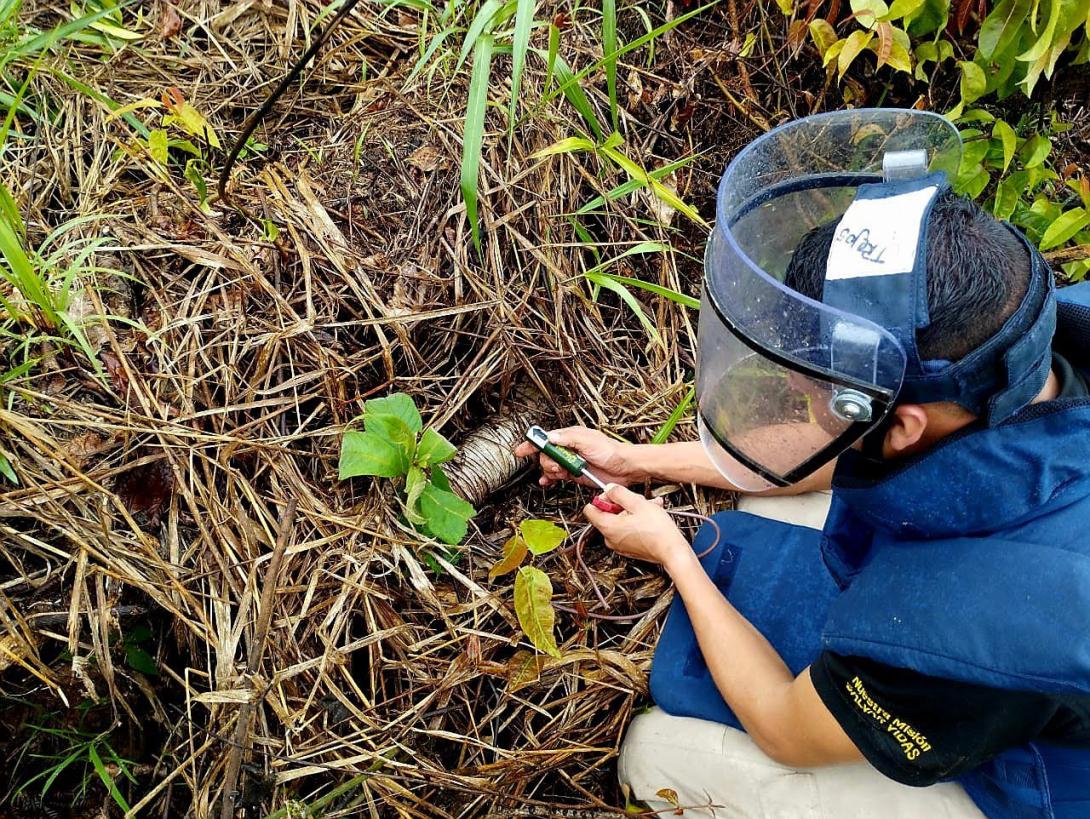
After eight years of unbreakable efforts, 27 sectors of this Huila municipality were decontaminated by soldiers of the Humanitarian Demining Engineer Battalion No. 5 who gave hope back to the communities affected by this problem.
With manual demining techniques, with professionalism, discipline and constancy, mine clearance specialists of Colombian National Army intervened in the villages of Naranjales, Filo Seco, Venadito, El Progreso, Bejucal, La Parada, La Batalla, Cerro Negro, Siria, Hotel, Soto, Patía, Cañón, Manzanares, El Salero, Miramar, San Pablo, Montellano, Begonia, San Juan and Los Laureles.
During the operations in this area, the commander of the 5th Humanitarian Demining Engineer Battalion, Lieutenant Colonel Edinson Santos Tapias, said: "The mine clearance specialists cleared about 200,000 square meters where they destroyed 17 anti-personnel mines, two unexploded ordnance and an improvised explosive device. One of the most critical points was Sector 15, in the village of Los Laureles, where the highest level was reported. More than 94,500 square meters were intervened there, with the destruction of 12 anti-personnel mines and one unexploded ordnance.”
In the same way, the Non-Technical Study teams are making progress in sectors such as La Unión, La Espinaloza, Totumito, Vaticano, La Troja and La Honda, which are included in a part of the protected area of the Tatacoa Desert, one of the main touristic and environmental attractions of the country.
"The work in this area represented an extreme challenge due to the high temperatures, which ranged between 40 and 42 degrees Celsius, it was an arduous and demanding job, but the commitment and professionalism of the mine clearance specialists managed to make progress in complex territories,” said the unit's operations officer, Major Sebastian Lara.
The demining in Baraya represents not only security, but in the same way hope. More than 5,000 people have been trained in mine risk education, strengthening prevention and protecting the inhabitants.
According to searches by the peace commissioner's office, the municipality of Baraya, department of Huila, reports 37 victims of anti-personnel mines: 32 members of the Military Forces and five civilians, including a minor who, when he was going to visit his parents, died when an explosive device was activated.
Main challenges
Despite the progress, challenges remain. In the so-called zone 2, which includes villages such as Rioblanco and La Libertad, contaminated areas continue to exist.
By 2017 and 2023, 316,000 square meters were cleared in this area, with the destruction of 91 anti-personnel mines and seven unexploded ordnance. However, more than 109,000 square meters remain to be intervened.
For its part, the municipal administration thanked the work achieved by the mine clearance specialists and reiterated its call to reactivate the demining work. “We hope that the teams can return to the pending areas. "This will enable us to completely liberate the municipality, allowing productive agricultural and livestock projects to boost Baraya’s development." said Alexander Herrera Ortiz, secretary of government.
This progress in humanitarian demining in this part of the municipality represents a firm step towards the consolidation of peace, the recovery of the territory and economic reactivation, returning tranquility to the communities that for years coexisted with the risk of explosive devices.
By 2024 and 2026, throughout Colombian territory, the military Forces have presented 306 municipalities free of suspected mines, destroyed 1,549 improvised explosive devices, 4,723 anti-personnel mines and 1,283 unexploded ordnance. In the same way, more than 349 thousand square meters have been cleared with the support of trained dog and more than 14 million square meters manually.
Source: Press - Ninth Brigade


