

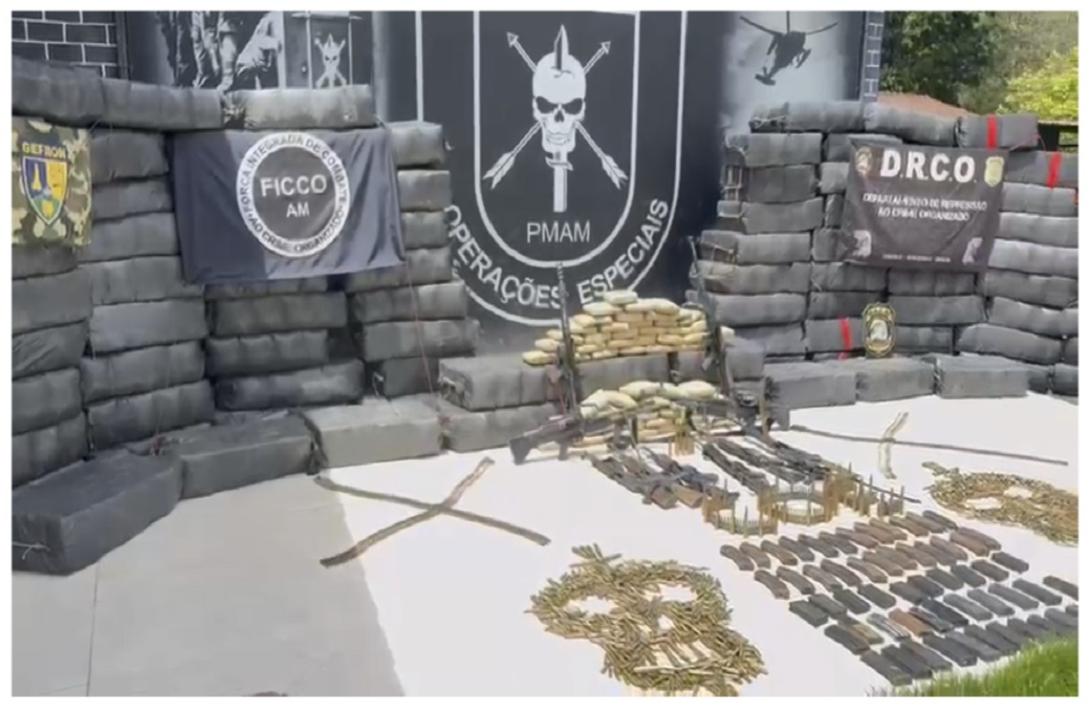
During the military operations, different narcotics were seized, including skunk-type marijuana, which reports high prices on the black market.
Within the framework of a joint and combined operation conducted by the Colombian Navy and the Brazilian Federal Police, a powerful result against illegal activities in the border area was possible.
The operation took place thanks to the intelligence work of the Amazon Information Fusion Center and the Amazon Coast Guard Command, which managed to execute joint operations aimed at directly striking the chain of production, collection and transportation of illicit drugs that hit Brazil and Colombia.
As a result of this inter–institutional action, carried out on the Solimões River, in Manaus - Brazil, it was possible to intercept two armored boats each with two high-capacity engines that were transporting 426 kilograms of cocaine hydrochloride, 3,945 kilograms of skunk-type marijuana, 10 long-range firearms with more than 3,000 cartridges of different calibers, as well as satellite communication equipment, radios and cell phones.
It is worth noting that skunk-type marijuana is a hybrid cannabis variety that characterizes by its extremely heavy and penetrating smell, and by having a significantly higher concentration of THC, which is the main psychoactive component, than traditional marijuana. Usually, this variant is not sown in the open, but in greenhouses under strictly controlled conditions of light, humidity and temperature to maximize its power and yield. In the context of anti-drug trafficking operations, skunk is considered a high-value product on the black market because its narcotic and nervous system-altering effects are much faster and more intense for the consumer.
This confiscation represents a loss of 22 million dollars to the finances of criminal structures and prevents the commercialization of more than one million doses of cocaine and about 700 thousand doses of marijuana on the international market.
This operation demonstrates the high level of binational coordination and cooperation, as well as the permanent commitment of the participating institutions to decisively confront drug trafficking and its related crimes, which hit security, the environment and the tranquility of communities.
Source: Press - Navy of Colombia


