

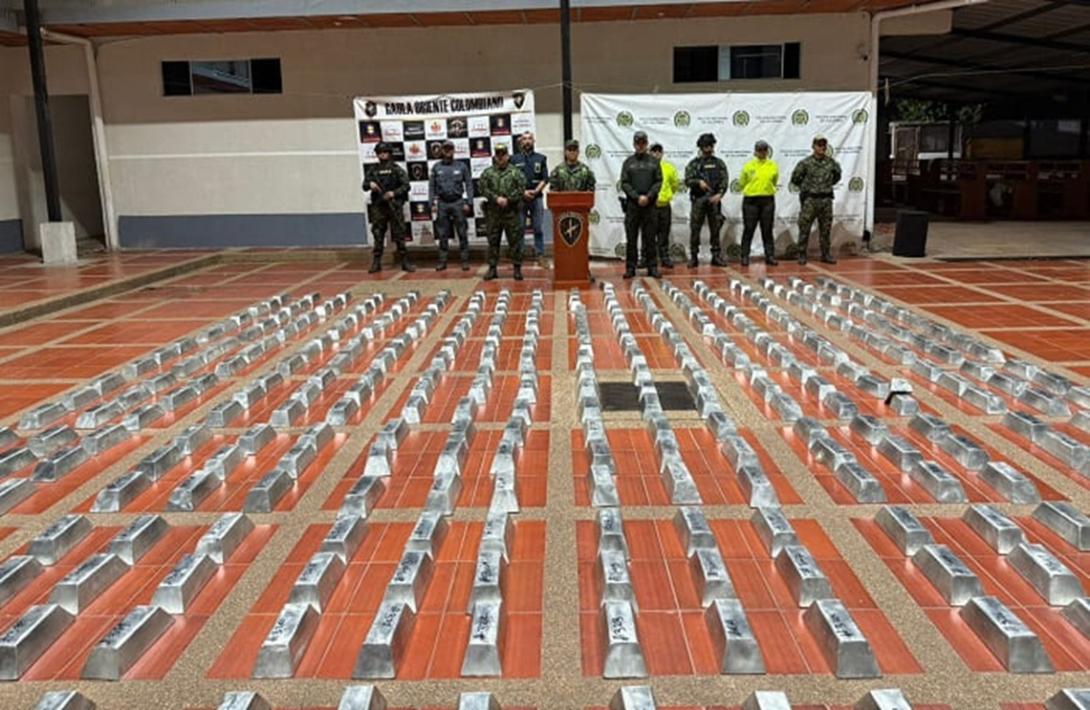
In a simultaneous military operation that took place in Puerto Carreño, department of Vichada, and Bogotá, troops of the Military Gaula (Anti-Extortion and Anti-Kidnapping Group) of Eastern Colombia and the Sijín of the Police seized a gigantic cargo of an element previously identified as tin, which would have a cost of more than one million dollars.
Within the framework of the Ayacucho Plan and the execution of coordinated operations, the Twenty-Eighth Brigade, through the Military Gaula (Anti-Extortion and Anti-Kidnapping Group) of Eastern Colombia, in a joint operation with the National Navy and the Colombian Aerospace Force, coordinated and inter-institutional with the Sijín of the National Police, CTI (Technical Investigations Corps) of the Prosecutor's Office and the Directorate of National taxes and customs, thwarted the shipment and commercialization of a gigantic cargo of a mineral previously identified as tin, which would leave from Puerto Carreño, in Vichada, to the city of Bogotá, with final destination to China.
This operation, which took place simultaneously in Puerto Carreño and Bogotá, learn through military intelligence, that at the Germán Olano Airport, in the capital city of Vichada, several tons of the metal would come with characteristics that would indicate that it would be tin, which led to immediate action, and more than 380 ingots of this mineral were seized. Subsequently, the authorities who were at the El Dorado International Airport carried out the second phase of this operation, seizing more than 50 ingots that would be ready to be sent abroad.
According to military intelligence, this mineral has been obtained in Venezuela with a route through Puerto Carreño to the capital city of the country. The criminal objective of individuals for this shipment was to enter it into international markets, mainly in Asia; it should be noted that a kilogram of this mineral in Colombia would have an approximate cost of 50 dollars.
The investigation and review of the confiscation of the elements is ongoing with expert personnel in mineral identification.
Through this result, it was possible to strike a powerful blow at the heart of the illicit activities of the different organized armed groups that commit crimes not only in Colombian territory, but in the same way to protect mining sites, preventing environmental pollution in biodiversity areas, such as the Orinoquía region.
Source: Colombian National Army


