

Landing in Antarctica is a maneuver that requires absolute precision in an environment where the snow blurs visual references, the horizon is confused with the terrain and every decision depends on technical knowledge, the discipline of the military operation and training.
From the air, this continent is perceived as a continuous and endless white block, in the middle of that immensity, a runway appears, where the landing depends less on the constructions and more on the pilot.
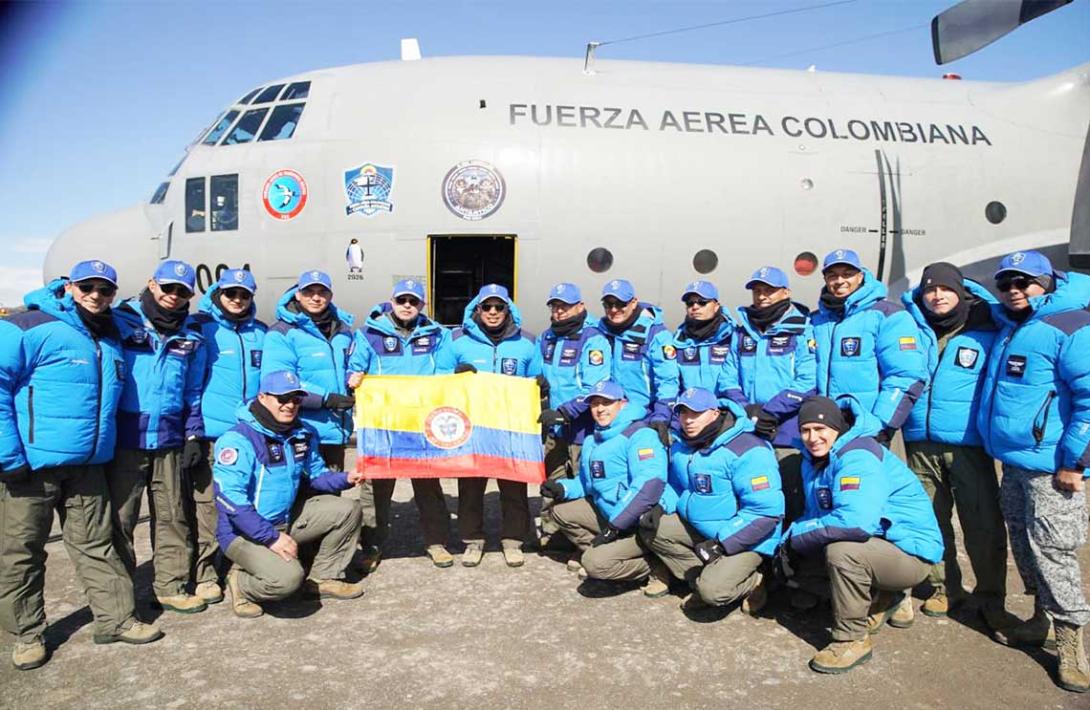
Within the framework of the VIII Air Campaign of the Colombian Air Force and the XII Antarctic Expedition of Colombia, the Colombian Aerospace Force made successful landings on King Jorge Island, consolidating a military operation capability that the country has been strengthening campaign after campaign on the White Continent.
The maneuvers were executed in the C-130 Hercules, an aircraft that demonstrated its reliability in extreme conditions, during approaches to the Teniente Rodolfo Marsh Martin Airfield, an unprepared runway of approximately 1,300 meters, where the changing meteorology, the texture of the terrain and the limited constructions turn each landing into an exercise of technical criteria and precision of the military operation.
In Antarctica, the challenge is not only technical, but in the same way a question of time: the operations depend on short periods of the day during the austral summer, in which visibility, wind and the surface are ideal to operate safely, these moments are known as meteorological windows, very limited lapses in which the conditions meet the desired requirements to fly.
Outside that window, the runway actively disappears among fog, reflections of the ice, low cloud cover or winds that prevent the approach; operating in Antarctica means reading the time accurately and executing the maneuver exactly when nature is good.
During these operations, two Colombian Air Force crew members successfully completed their training and certification process as polar pilots, reflecting the work of instructors with extensive experience, who guided their students to make safe landings on one of the most challenging runways.
The accompaniment of the Chilean Air Force has been fundamental to ensure the continuity of the operation, especially in meteorological support, flight window planning and coordination for the entry to King George Island, demonstrating the importance of international integration.
And this, precisely, has been a determining pillar for the success of the air operations, in coordination with allied polar programs and under the spirit of cooperation of the Antarctic Treaty System, the Colombian Air Force has safely transported researchers, scientists and diplomatic representatives, as well as directives of the Chilean Antarctic Institute (INACH), among others, who have sent these requests within the framework of logistical and scientific cooperation.
This international coordination, which includes support in meteorology, flight planning, access to operation points and technical coordination, strengthens scientific and diplomatic exchange and reaffirms the joint commitment to peace, science and global cooperation promoted through the Colombian Antarctic Program.
The landings of the Colombian Air Force Hercules on the seventh continent represent the consolidation of a human, technical and military operation capacity that manages to work for the safe transport of researchers, equipment and cargo, and consolidate training on polar runways as a sustainable institutional capacity.
Source: Office of Strategic Communications


