

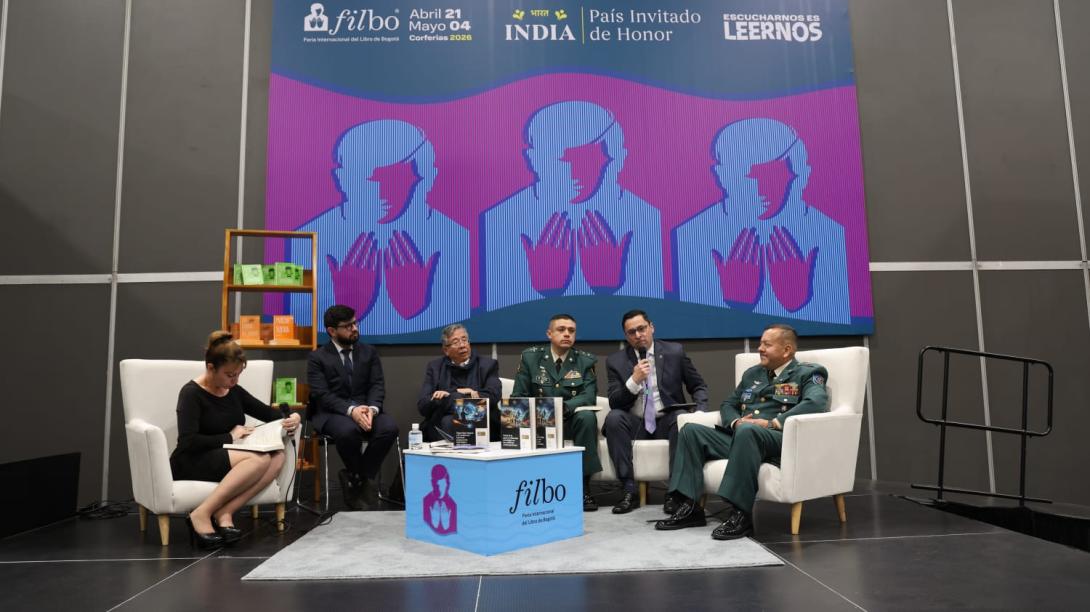
On the seventh day of the Bogotá International Book Fair (FILBo) 2026, the General Rafael Reyes Prieto Superior War College consolidated its leadership as a center of strategic thinking by presenting an academic agenda focused on the challenges of the future of war, technological innovation and national resilience, positioning Colombia in the global discussion on security and defense.
The activity began with the presentation of the books Teoría de la guerra y liderazgo estratégico en los conflictos contemporáneos (Theory of war and strategic leadership in contemporary conflicts) and Seguridad integral y resiliencia nacional: preparación estratégica ante amenazas contemporáneas (Comprehensive security and national resilience: strategic preparation for contemporary threats), two works that pose a deep reflection on the evolution of leadership in conflict environments and the vulnerability of the State to anticipate, resist and adapt to increasingly complex and multidimensional threats.
In line with the technological transformation of defense, the agenda progressed with the presentation of the book Aplicación de la IA y ética en el diseño de soluciones interdisciplinares para defensa (Implementation of AI and ethics in the design of interdisciplinary solutions for defense), which highlights the role of artificial intelligence as a strategic tool, underlining at the same time the importance of incorporating ethical principles in its development and implementation. This vision was complemented by the work La revolución de las tecnologías de defensa: impacto en la seguridad nacional (The revolution of defense technologies: A blow to national security), which analyzes how technological innovation redefines military resources and security environments in the global context.
The strategic reflection was projected into the future with the presentation of the book Desafíos futuros en los dominios aéreo, espacial y ciberespacial: IA y revolución industrial 5.0 (Future challenges in the air, space and cyberspace domains: AI and industrial revolution 5.0), which addresses the expansion of military operation domains and the vulnerability of integrating new resources in highly dynamic environments. Along the same lines, the book Crisis, riesgo y estrategia: ¿cómo el CESAC entrena la toma de decisiones? (Unmanned aircraft and spacecraft system and artificial intelligence: strategic innovations for the military future) highlighted the impact of autonomous systems in the transformation of operations and strategic superiority.
One of the most innovative areas of the activity was the presentation of the Crisis Simulation and Analysis Center (CESAC) with the focus Crisis, riesgo y estrategia: ¿cómo el CESAC entrena la toma de decisiones? (Crisis, risk and strategy: how does CESAC train decision-making?), highlighting the value of simulation as a key tool to prepare leaders in contexts of high uncertainty, where anticipation and timely decision-making are decisive.
The closing of the agenda was marked by the presentation of the book Huella Militar Cero: estrategias para una defensa sostenible (Zero Military Footprint: strategies for a sustainable defense), a purpose that incorporates sustainability as a strategic axis of modern defense, aligning military resources with environmental responsibility and the global challenges of sustainable development.
Through this agenda, the Superior War College reaffirms its ability to integrate strategic thinking, technological innovation and sustainability into a comprehensive vision of security and defense. Its participation in the FILBo 2026 not only strengthens the dissemination of knowledge, but in the same way positions the institution as a key actor in the construction of strategic responses to the challenges of the future.
Source: Press - Superior War College


