

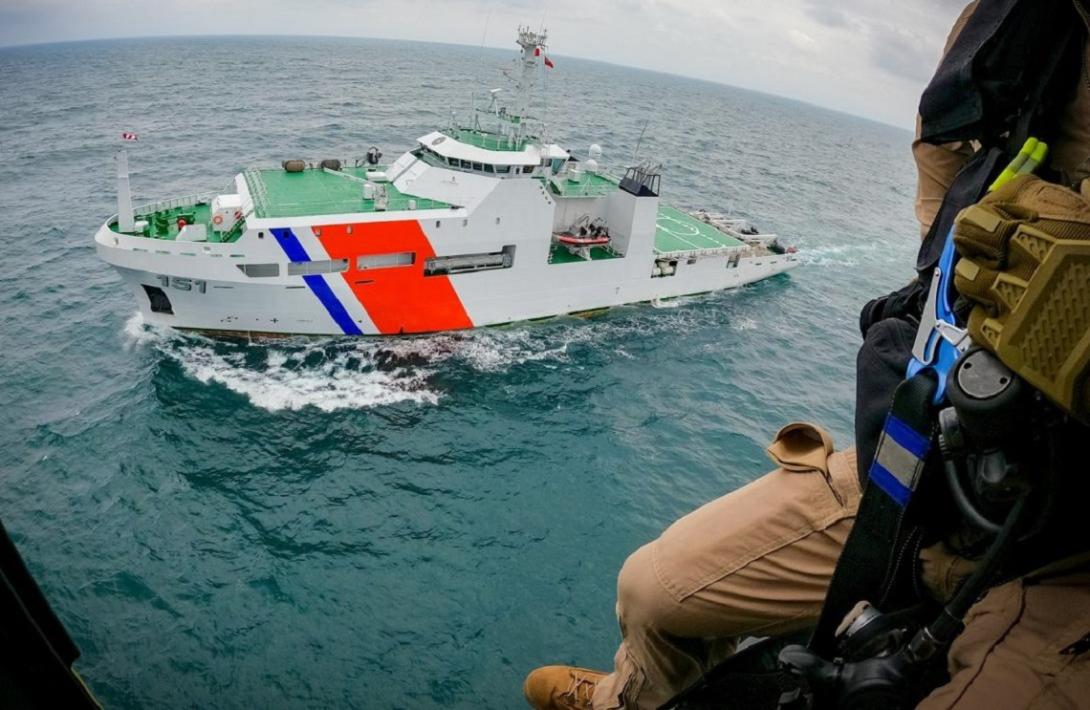
During her navigation through the waters of the South Pacific, she visited the ports in Valparaiso and Punta Arenas.
Within the correct time window, the transit by the Drake passage was crossed without any problem and with the most favorable meteorological conditions.
After its departure on December 06, 2025 at the dock of the Naval Base of Cartagena, the Navy scientific ship ARC Simón Bolívar continues its journey towards the white continent. This is a country mission that is sailing towards this territory of science, peace and international cooperation, with projects aimed at evaluating the impact of humans in Antarctica and its correlation with phenomena that occur in Colombia.
In this way, after the embarkation of the last group of scientists in Punta Arenas was completed, the final route to enter Antarctica began. For their part, the Sea Leopards, as the crew of this flagship of science in the country is called, have sailed more than 5,000 thousand nautical miles.
After crossing the Panama Canal and being welcomed by the Pacific Ocean with heavy swells and light winds, they visited two international ports in Chile: Valparaíso and Punta Arenas, traveling by some of the most striking landscapes of the Patagonian canals.
Crossing the transit of the Drake passage, considered one of the most challenging for sailors in the world, represented the greatest challenge for this floating laboratory, putting into practice the preparation received months before. Thanks to their experience and knowledge in polar waters, officers of the Chilean Navy accompany this crossing, supporting the most challenging maneuvers of the South Pacific. Contrary to expectations, the Drake welcomed the scientific giant with maximum waves of 2.5 meters and winds of 20 km/h, ideal climate conditions for crossing this dreaded sea.
It is important to note that the transit through the Pacific Ocean was not only the obligatory transit to Antarctica, but in the same way an environment for science. During this journey, eight oceanographic stations were carried out, which consist of collecting water samples at a depth of 1,500 meters, using the Niskin bottles (sampling bottles), a fundamental process for the ICEMAN (Marine Scientific Research for Maritime Safety in Antarctica), a flagship project of the General Maritime Directorate (DIMAR). Station nine took place during the transit by the Drake passage.
After leaving the continent, the ARC Simón Bolívar arrived in the Chacón Inlet sector, Chile, where, as part of international cooperation, it landed nine tons of food and items at the Pedro Vicente Maldonado Scientific Station (PEVIMA) in Ecuador. These supplies had previously been shipped in Punta Arenas, thus fulfilling one of the principles that govern this polar continent.
In the same way, the Simon Bolivar will visit 10 Antarctic bases: Brazil, Bulgaria, Chile, China, South Korea, Ecuador, the USA and the United States. UU, Spain, Peru and Uruguay, as part of the relationship among the nations and the exchange of experiences with countries that, for years, have done science in this southern territory.
There will be 30 days specialized in science in the white continent, through 12 research projects. Subsequently, the crew will return to Colombia, on February 17, 2026, with the satisfaction of the duty fulfilled and with dreams come true in a journey that challenged the bravery, confidence and knowledge of the Sea Leopards on board the ARC Simón Bolívar during the 123 days of operation of the XII Scientific Expedition of Colombia austral summer 2025 – 2026.
Source: Press – Navy of Colombia


