
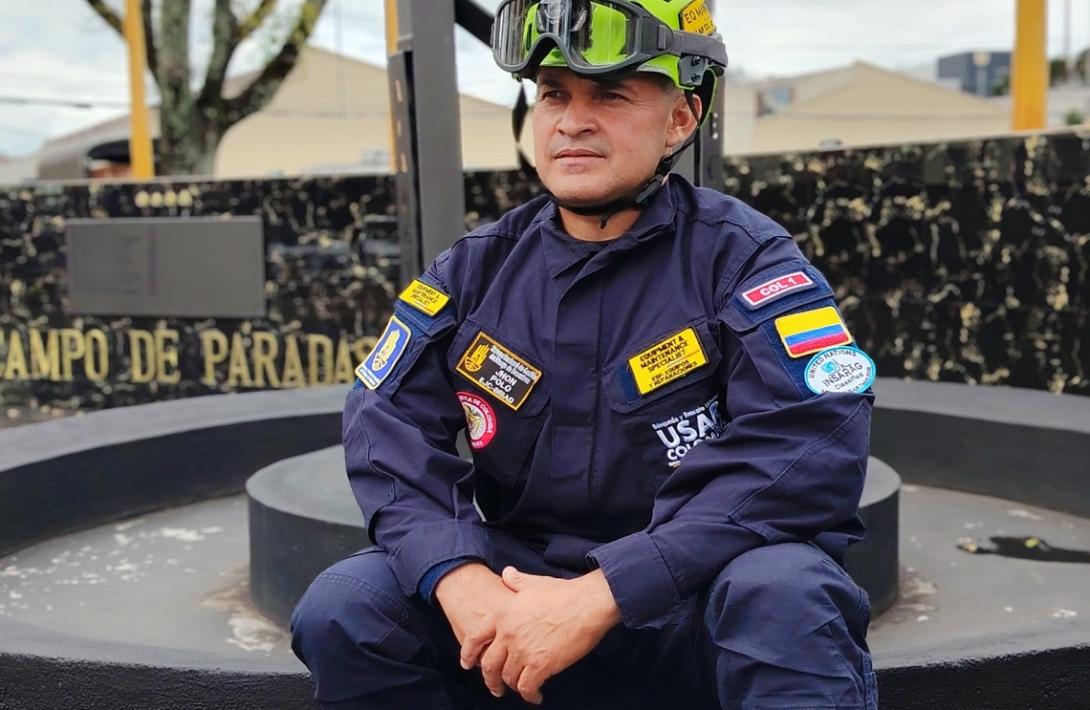
A few weeks ago, he joined the USAR COL-1 team that managed to maintain Colombia's international INSARAG certification of the UN. Today, First Sergeant John Freddy Polo Santos was summoned to support an eventual search and rescue mission following the reported emergency in Venezuela. "If it is necessary to take off my boots to give them to a rescuer to fulfill his mission, I do it."
The phrase, uttered by First Sergeant John Freddy Polo Santos about his participation in the USAR COL-1 team, today gets a different meaning. While the authorities are providing support in the emergency generated by the reported earthquake in Venezuela, the non-commissioned officer was summoned as a member of the Colombian team specialized in urban search and rescue, a capacity that could be sought to support humanitarian work in the neighboring country.
Just a few weeks ago, Sergeant Polo was part of the 62 specialists and four rescue dogs that went from Colombia to maintain the United Nations INSARAG international certification, the world's highest standard for search and rescue teams in collapsed structures. Now, the resources that were evaluated during that demanding process could be put at the service of a real emergency.
When an earthquake strikes, the images usually focus on those who remove debris, find survivors or enter unstable structures to save lives. However, behind each rescuer there is a group of specialists whose operation is just as important for the success of the mission. Sergeant Polo is there.
With more than two decades of service in Colombian National Army and in the engineer subsystem, this non-commissioned officer is part of the support component of the military operation, a fundamental capacity to work because search and rescue operations advance in a safe, organized and efficient way.
Their work begins long before the teams arrive at the emergency zone. The revision of tools, the organization of the load, the control of inventories, the maintenance of equipment, the logistical coordination and the distribution of resources are part of a silent responsibility that can make a difference when every minute counts.
"Behind every rescuer there has to be someone who supports him. Military operation support is the backbone of a search and rescue operation. The rescuer must feel that he has permanent support to fulfill his mission," explains the sergeant.
His entry into the USAR COL-1 team was the result of years of experience and preparation. About 900 applicants from different institutions of the country participated in the selection process that form the Colombian urban search and rescue team. after several phases of instruction and evaluation, he was chosen to join the group that represented Colombia during the international recurrent certification process.
For the non-commissioned officer, that opportunity meant much more than a professional accreditation.
"Representing Colombian National Army and all the soldiers who are part of this institution was an enormous pride. The work of many years was reflected there," he recalls.
Finally, Colombia maintained the INSARAG certification and ratified its resources to respond to large-scale disasters. Sergeant Polo was accompanied by a deep feeling of gratitude towards his family, his comrades and Colombian National Army.
Today, while he remains attentive to a possible international humanitarian support mission, he understands that all the preparation received has a higher purpose: to be ready to serve when people need it most.
For this reason, he has in mind a phrase that summarizes the essence of his work: Beyond the Rubble, an expression that reflects the commitment of those who work behind each rescue operation and who, even away of the cameras, make it possible for others to save lives.
Source: Press – National Army


